Commercial and residential metal roofs can use similar materials and systems, but the project decisions behind them often differ. A commercial roofing project is shaped by the building’s use, its scale, who’s involved in approving the work, and how the project affects day-to-day operations — factors that rarely come up on a house. Here’s what actually changes when the building is commercial.
| Factor | Residential | Commercial |
|---|---|---|
| Typical decision maker | Homeowner | Property manager, building owner, or facilities lead |
| Roof configuration | Simpler, often steeper-pitched | Larger, sometimes low-slope, more roof penetrations |
| Occupancy during the project | Household’s own schedule | Business operations, tenants, staff, or equipment |
| Maintenance approach | Often reactive, after a problem appears | More often routine and inspection-based |
Why Building Use Changes the Roofing Decision
A house is occupied by one household, on a schedule that household controls. A commercial building might house a warehouse operation running shifts, an office with tenants, or a retail space that can’t close for a workday without a real cost. The roof still has to keep water out either way, but what “planning the project” means around that use is different — a homeowner is usually deciding for themselves, while a commercial building often has a business running underneath the roof while the work happens.
Roof Configuration and Scale
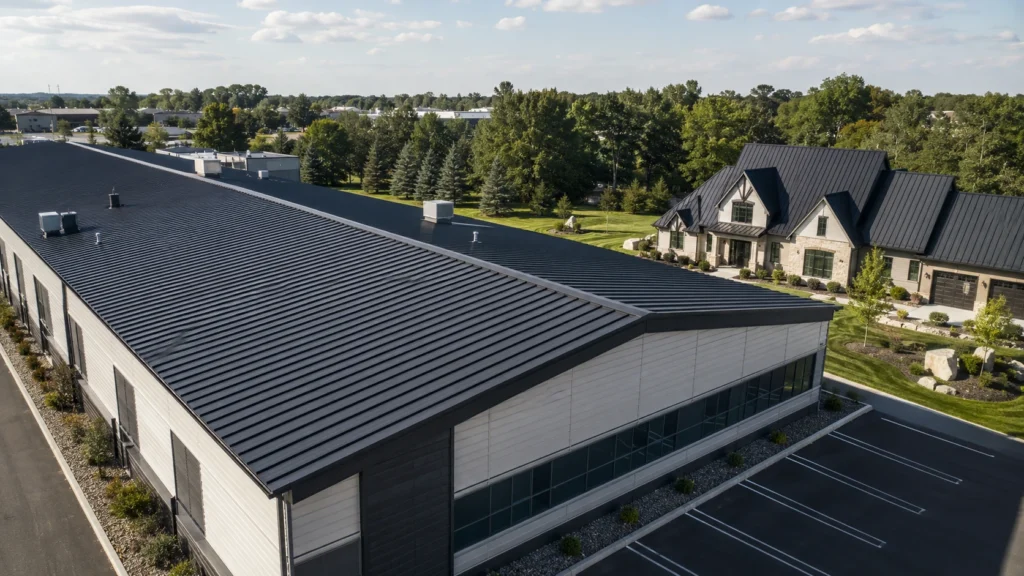
Commercial roofs are frequently larger and structured differently than a house roof — longer spans, different roof pitches (including low-slope sections that aren’t common on residential roofs), and more roof penetrations for HVAC units, vents, and other equipment. That doesn’t make every commercial roof automatically more complicated than every house roof, but it does mean a commercial roofing project usually has more roof-specific details to account for before work starts.
Who’s Involved in the Decision
On a house, the roofing decision is usually made by the homeowner. On a commercial building, it’s often a property manager, a building owner, a facilities lead, or some combination of the three — and the roofing project may need to fit into a broader capital planning or budget cycle rather than being decided on its own. That tends to change the pace of the decision more than it changes the roofing work itself.
Installation Planning and Business Operations
A residential roofing project generally needs to work around a household’s schedule. A commercial roofing project more often needs to work around a building’s operations — tenants, staff, customers, or equipment that can’t simply pause for the length of the project. Scheduling, access, and staging tend to get more attention on a commercial project for exactly that reason.
Maintenance and Inspection Differences
Homeowners often think about their roof reactively, after a leak shows up. Commercial buildings more frequently use routine inspection as a way to catch smaller issues — fastener wear, minor panel movement, flashing concerns — before they become a larger repair or an unplanned disruption. That’s not a rule that applies to every building or every homeowner, but it’s a common pattern in how commercial properties approach roof upkeep.
How System Selection Differs
The metal roofing system itself can also be a different conversation. Standing seam metal roofing shows up on both houses and commercial buildings, but a commercial project weighs it against a wider set of considerations — roof slope, expected building lifespan, maintenance approach, and how the roof interacts with the rest of a commercial structure. A closer look at how commercial building owners compare system options is covered separately in Commercial Metal Roofing Systems: How Building Owners Compare Options.
When to Get a Professional Commercial Evaluation
If you’re a commercial building owner or manager reading this because you’re trying to figure out whether your project needs a different approach than a typical home roofing job, it may — particularly given differences in building use, roof configuration, who’s involved in the decision, and how the building operates. The more useful next step is usually a conversation about your specific building, not a general comparison like this one.
If that’s where you are, Heritage Metal Roofing’s Commercial Metal Roofing Services page covers what a commercial project with Heritage looks like, from installation and replacement to repair and maintenance.