Metal roofing outperforms asphalt shingles on lifespan, weather resistance, and long-term maintenance — but it costs more to install upfront. For Michigan homeowners who plan to stay in their home long-term, that trade-off often makes sense. For someone who expects to sell within five to ten years, the math looks different. This guide walks through both sides honestly.
The Short Answer
The main advantages of metal roofing are longevity (typically 40 to 70 years), stronger performance in demanding weather, and minimal maintenance over the life of the roof. The primary drawback is higher upfront installation cost compared to asphalt shingles. Whether that trade-off is worth it depends on your timeline, your budget, and how you weigh long-term performance against what you spend today.
What Makes Metal Roofing Worth Considering
Why metal roofing attracts serious attention from long-term homeowners comes down to a few performance characteristics that separate it from other residential roofing options.
It Lasts Significantly Longer Than Asphalt Shingles
A quality metal roof typically lasts 40 to 70 years. Asphalt shingles typically last 15 to 30 years, depending on product grade, installation quality, and the climate conditions they face.
In Michigan’s climate, shingle lifespan tends toward the lower end of that range. Freeze-thaw cycling, seasonal snow loads, and the temperature swings between summer and winter put roofing materials under stress that moderate climates never impose. Metal does not lose granules, curl at the edges, absorb moisture, or crack under repeated temperature cycling the way asphalt can over time.
For a homeowner planning to stay for 20 or more years, that difference can be meaningful. Over a long ownership horizon, the conversation often shifts from the first installation cost to the possibility of avoiding one or more future asphalt replacements.
It Handles Michigan’s Climate Better Than Most Roofing Systems
Michigan’s weather is genuinely hard on roofing materials. Cold winters, hot summers, significant snowfall, and repeated freeze-thaw cycles create conditions that accelerate wear on materials not designed to handle them.
Metal roofing performs well across all of these conditions. Standing seam systems use hidden clips that allow panels to move freely as temperatures shift — the design accommodates thermal movement rather than resisting it. Snow sheds cleanly off a smooth panel surface, which reduces roof load and limits the conditions that lead to ice dam formation. Asphalt shingles hold snow at the surface and create the temperature differential at the eave where snowmelt refreezes — the mechanism behind ice dams and the water intrusion that follows.
Maintenance Is Minimal Over the Life of the Roof
Asphalt shingle roofs require attention over time. Granules wash away. Edges curl. Moss establishes on shaded areas. Individual shingles blow off in wind events. A properly installed metal roof requires very little ongoing maintenance — periodic inspection of flashing and sealants is sensible, but the material itself does not degrade the way asphalt does. No granule loss, no UV cracking, no lifting edges.
Energy Performance — The Reflective Coating Advantage
Metal roofing with reflective coatings absorbs less solar heat than dark asphalt shingles, which can reduce cooling loads during warm months. The degree of benefit depends on the coating, roof color, and attic insulation. In Michigan’s climate, where summers carry real cooling costs, it is a genuine secondary benefit — not the primary argument for metal, but it adds to the long-term value case.
Curb Appeal and Long-Term Resale Value
Standing seam metal roofing has a clean, architectural profile that reads differently from asphalt shingles. When homeowners weigh the benefits of a metal roof vs shingles, resale appeal is usually part of the conversation. Resale value is difficult to quantify precisely, but a metal roof that is still performing well ten or fifteen years in can be a point of confidence for buyers thinking about future maintenance.
Where Metal Roofing Falls Short
No honest review of the metal roofing pros and cons omits the drawbacks. There are several worth understanding before making a decision.
The Upfront Cost Is Higher Than Asphalt Shingles
This is the most significant barrier for most homeowners, and it deserves direct acknowledgment rather than minimizing. Metal roofing costs meaningfully more to install upfront than asphalt shingles.
The long-term cost of ownership argument is often what keeps metal roofing in consideration. For homeowners who expect to stay in place for decades, the possibility of avoiding multiple asphalt replacements can make the higher upfront cost easier to justify. For shorter ownership timelines, that advantage is less clear.
For a full breakdown of what metal roofing costs and how it compares to asphalt over time, see our metal roofing cost guide.
Installation Requires a Contractor Who Knows the System
Not every roofing contractor has meaningful experience with metal systems. For standing seam specifically, the difference between an experienced and an inexperienced installer shows up in long-term performance. Proper installation requires accurate panel layout, correct clip spacing, and careful work at every flashing transition, penetration, valley, and ridge. General roofing experience does not fully substitute for metal-specific experience. Choosing a contractor who does metal regularly — not occasionally alongside shingles work — is part of getting the result the product is capable of.
Noise — What the Evidence Actually Shows
The concern that metal roofs are loud in rain is one of the most persistent misconceptions about the material. In a standard residential assembly, with solid decking and appropriate underlayment, metal roofing is generally not meaningfully louder indoors than asphalt. The louder sound people associate with metal usually comes from installations over open framing, which is common in agricultural buildings and is a very different assembly from residential standing seam.
Not Every Roof Geometry Is Equally Straightforward
A simple gable roof is a straightforward metal project. A roof with multiple valleys, dormers, skylights, or several penetrations requires more precision and time. This is not a reason to rule metal out on a complex roof, but it is worth discussing specifically with any contractor you are evaluating. The answer tells you a great deal about their experience with the system.
How Metal Roofing Compares to Asphalt Shingles
At a high level, metal tends to win on lifespan, weather resilience, and maintenance, while asphalt usually wins on upfront affordability and contractor availability.
Where the comparison becomes more nuanced is in the details — specific cost differentials, lifespan data by climate, energy efficiency figures, and the long-term cost-of-ownership math that accounts for replacement cycles over 40 or 50 years. Those details belong in a structured comparison, not a general overview.
If you want a complete side-by-side analysis with cost and performance data, see our full metal roofing vs. shingles comparison.
A Note on Standing Seam
Not all metal roofing is the same product. The category includes exposed-fastener corrugated panels, through-fastened structural systems, and standing seam — and these differ meaningfully in design, performance, and installation requirements.
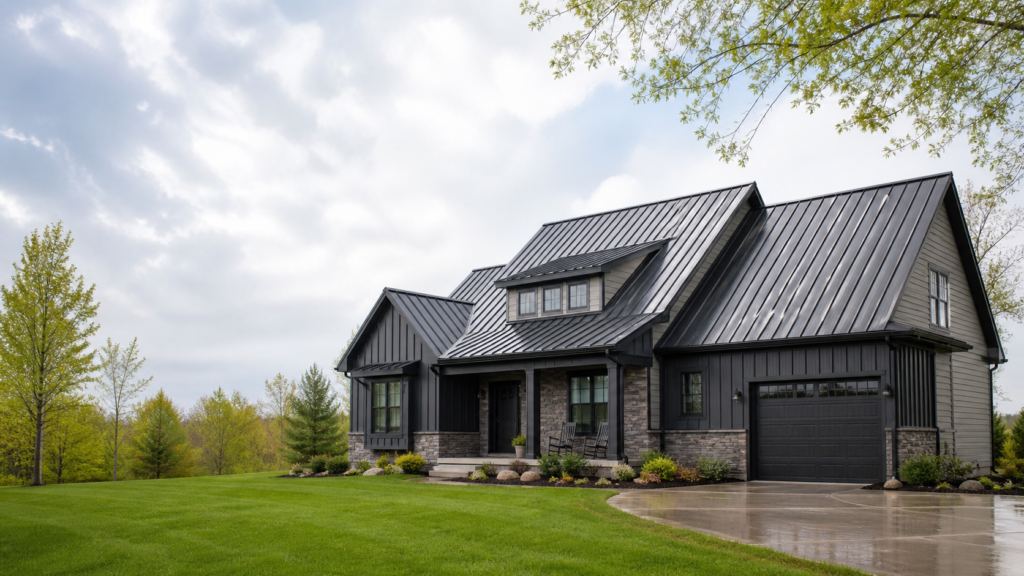
Standing seam is the premium tier of residential metal roofing. The defining feature is the concealed fastener: panels interlock at raised vertical seams with no screws or fasteners exposed on the roof surface. The clips that hold the panels to the deck are hidden inside the seam, which eliminates the exposed penetrations that are the primary long-term vulnerability in through-fastened systems. That design also allows panels to float and move as temperatures change without stressing the fastening points.
Heritage Metal Roofing specializes in standing seam installation. For a more complete explanation of standing seam metal roofing and what the installation process involves, see our standing seam metal roofing service page.
Is Metal Roofing a Good Fit for Michigan Homes?
For Michigan homeowners specifically, several of metal roofing’s strongest performance characteristics line up directly with the demands of the local climate.
Freeze-thaw resilience. Michigan winters include significant freeze-thaw cycling — temperatures drop below freezing and rise above it repeatedly throughout the season. Asphalt shingles absorb more moisture than metal and are more vulnerable to the gradual physical damage this cycling causes over years. Metal does not absorb moisture in the same way and handles the thermal cycling without the granule loss, cracking, or curling that shortens asphalt’s useful life in this environment.
Snow shedding. Standing seam’s smooth surface allows snow to slide off rather than accumulate. This reduces structural load and, more importantly, reduces the conditions that produce ice dams. Asphalt shingles hold snow at the surface, which allows the snowpack to partially melt during the day and refreeze at the colder eave overhang — the mechanism that drives ice dam formation.
Temperature range performance. Michigan’s climate runs from cold winters to warm summers. The expansion and contraction that comes with that range affects every material on a roof. Standing seam’s clip-based attachment is engineered to accommodate this movement rather than resist it.
Long-horizon decision logic. An asphalt roof in Michigan may realistically last 15 to 20 years in practice because of climate demands — toward the lower end of its theoretical lifespan. Framing metal’s 40 to 70-year service life against that compressed shingle lifespan makes the upfront cost premium more compelling here than it would be in a milder region where shingles regularly reach their upper limits.
What to Ask a Contractor Before You Decide
Before committing to metal roofing — or deciding against it — these are questions worth raising with any contractor you speak with.
How much of your work is metal roofing? A contractor who focuses on metal is a different proposition from one who handles it occasionally alongside shingles work. For standing seam, that distinction matters.
How do you approach valleys, penetrations, and transitions? The flashing and detailing at every interruption in the roof plane is where long-term performance is determined. A contractor who can explain their specific approach here is more credible than one who offers general reassurance.
What does the warranty structure look like? There are two distinct warranties: the manufacturer’s material warranty on the panels, and the contractor’s workmanship warranty on the installation. Understand what each covers before signing anything.
Who does the installation? Subcontracting is common in the roofing industry. Ask whether the crew on your roof is the company’s own team and what that means for accountability after the job is complete.
What does my specific roof’s geometry mean for this project? If your roof has dormers, multiple valleys, or penetrations, ask the contractor to walk through how each will be handled. The quality of that answer tells you a great deal about their experience level.
Frequently Asked Questions About Metal Roofing
Is a metal roof better than shingles?
Metal roofing outperforms asphalt shingles on lifespan, weather resilience, and long-term maintenance. Asphalt costs less upfront and is more widely available. Whether metal is “better” depends on how long you plan to own the home, your budget, and how you weigh long-term performance against immediate cost. For a full side-by-side comparison, see our metal vs. shingles guide.
What are the biggest disadvantages of metal roofing?
Higher upfront installation cost is the primary drawback. Beyond that: the need for a contractor with specific experience in metal systems, and more exacting requirements on complex roof geometries. Noise is frequently cited but is not a meaningful issue on a properly installed residential system with solid decking and underlayment beneath the panels.
How long does a metal roof last?
A quality metal roof typically lasts 40 to 70 years. Asphalt shingles typically last 15 to 30 years depending on product grade, installation quality, and climate. In Michigan, shingle lifespan tends toward the lower end of that range, which makes the difference between the two systems more consequential than it would be in a milder region.
Does a metal roof make more noise when it rains?
Not in a standard residential installation. A metal roof on solid decking with underlayment performs comparably to asphalt for interior sound levels during rain. The louder noise associated with metal comes from agricultural and commercial buildings with open framing and no solid decking beneath the metal — a fundamentally different assembly from residential standing seam.
Why do homeowners in Michigan choose metal roofing?
Primarily for long-term performance in a demanding climate. Freeze-thaw resilience, clean snow shedding, ice dam resistance, and the ability to handle wide seasonal temperature swings make metal a logical choice for homeowners planning to stay in their home for 20 or more years. Replacing an asphalt roof once or twice over the same period is a real cost that changes how the upfront premium looks over time.
If you have done the research and want to talk through what makes sense for your roof, contact Heritage Metal Roofing for a free estimate.