The short answer: On an exposed-fastener metal roof, screws go through the face of the panel and their heads stay visible on the roof. On a concealed-fastener roof, the fasteners that hold the panels are hidden within the system, so they are covered once the roof is finished. The two approaches look different, are installed differently, and ask different things of you over the years. “Concealed” also covers more than one attachment design, so knowing which one a proposal describes is what lets you compare it with another.
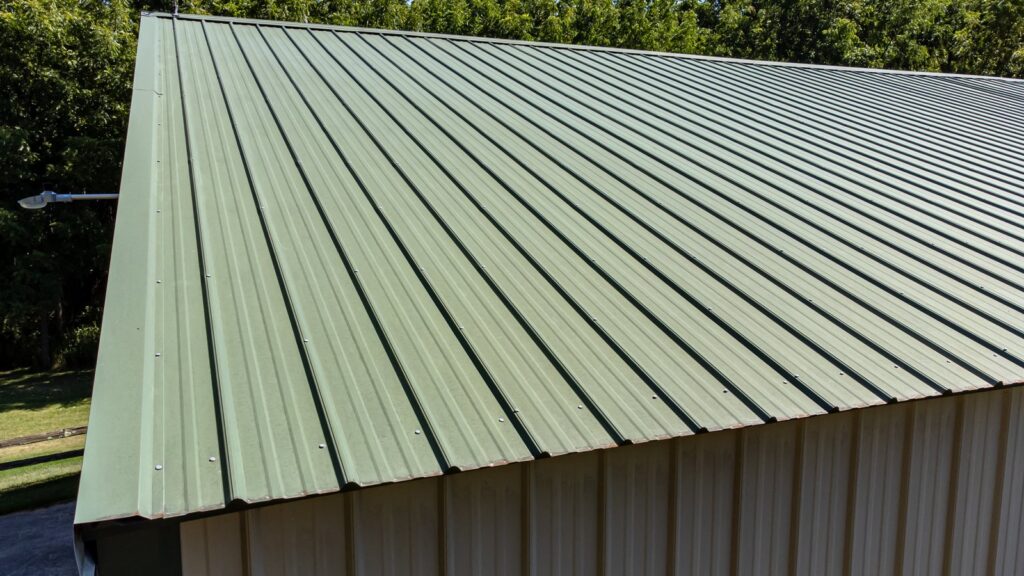
About the photo at the top of this guide: it shows an exposed-fastener panel roof on a metal-sided building, shown for comparison. It is a public-domain (CC0) photo from Wikimedia Commons and is not a Heritage project. The same photo appears with this guide on our blog page and in link previews. The credit is at the end of this article.
Four ways a metal roof is attached
The products named below are examples of each type, taken from the manufacturers’ own documents.
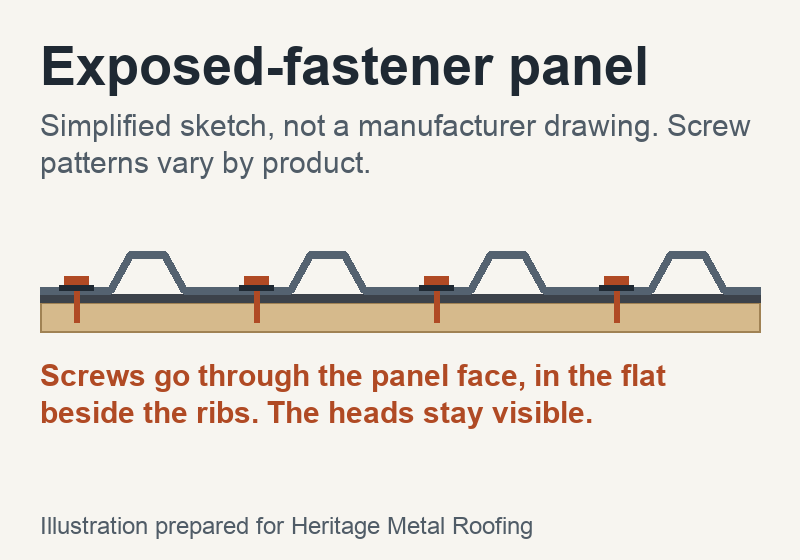
1. Exposed-fastener panels. These are the ribbed panels common on barns, garages and many homes. McElroy Metal describes its Max-Rib panel as an “exposed fastener” panel for residential, agricultural and light commercial roofs. Screws with sealing washers pass through the panel into the deck or framing, in a pattern the manufacturer sets. McElroy’s installation manual for the panel shows the screws in the flat of the panel beside each major rib.
2. Standing seam with clips. Standing seam uses long vertical panels joined at raised seams. On clip systems, the panels are held by metal clips fastened to the deck at the seams. McElroy’s installation manual for its Medallion-Lok panel is an example: its notes say to install each panel and “secure in place with clips,” and its details show a clip at the panel’s seam, screwed to the deck.
3. Standing seam with a fastening flange. Not every standing seam panel uses clips. McElroy describes its Meridian panel as a “clipless” concealed-fastener panel that “uses a prepunched fastening flange for attachment to the decking,” with a snap-together seam. It is still a concealed-fastener roof, attached a different way.
4. Interlocking metal shingles. Tilcor names its CF Shingle and CF Shake systems “Concealed Fastener.” Tilcor’s installation guide for those two systems shows the fasteners along each panel’s upper edge. The panels also engage one another in two directions. Side by side within a course, the guide shows a panel sliding into the previous one. Between courses, its installation notes give the headlap exposure “when fully engaged” and describe panels “interlocking into the headcheck” of a panel already in place. That guide covers CF Shingle and CF Shake only. Other profiles and other manufacturers’ metal shingles have their own instructions, so ask to see the guide for the exact product in your proposal.
“Concealed” does not mean no visible fasteners anywhere
On a concealed-fastener roof, the fasteners holding the main panels are covered. Some details can still use visible screws. Tilcor’s guide, for instance, fastens ridge and trim caps with painted screws, and McElroy’s Medallion-Lok manual shows a pipe flashing boot screwed to the panel around a vent pipe. A concealed-fastener roof therefore still has a small number of points worth looking at during an inspection.
What the difference changes
Appearance
Exposed-fastener panels show rows of screw heads across the roof. Standing seam shows vertical seams with no screws in the panel faces. Metal shingles look like shingles, shake or tile. Which look suits a house is a matter of taste and of the neighborhood.
Movement with temperature
Metal panels grow and shrink as their temperature changes. McElroy’s general guide for its standing seam systems says the roof design “should take into account that the roof panel will expand and contract with change in temperature,” and that roof clips “shall allow for thermal movement.” How a particular panel handles movement is set by its manufacturer, which is one reason the exact product matters. For exposed-fastener roofs, McElroy’s guidance on screws ties correct screw placement to allowing for the metal’s expansion and contraction.
Installation
Each approach depends on following the manufacturer’s instructions. On exposed-fastener panels, much of the care is in the screws: McElroy’s guidance warns that over-driving a screw can damage its washer and dimple the panel, and that under-driving it can leave the washer unseated and let water in. On concealed systems, the work shifts to panel layout, seams or interlocks, clips or flanges, and the trim and flashing at every edge and penetration. McElroy’s standing seam guide also says no penetrations should be placed in the panel system except as its drawings or manuals show.
Inspection and upkeep
Every roof benefits from being looked at periodically. What you look for differs.
- Exposed fasteners. McElroy’s guidance lists checking for loose or missing screws, signs of corrosion or wear, and degraded sealant around screws, with reviews after severe weather. Every screw is on the surface, so there are more points to check and they are easy to see.
- Concealed fasteners. The panel fasteners are covered. Attention goes to flashing, trim, sealant and the few visible screws at details. Tilcor’s guide refers owners to its warranty for tips on maintaining the roof and points to its walking instructions for anyone going onto it.
No roofing system is free of upkeep, and no fastening method makes a roof leak-proof by itself. Installation quality and detailing matter on both.
Cost
Manufacturers position these products differently. McElroy markets Max-Rib as an “economical” panel, and it says its clipless Meridian panel gives the look of standing seam “without the complexity or higher cost” of a traditional system. Those are one manufacturer’s descriptions of its own products, not prices for your roof. What they tell you is that bids for different systems are not directly comparable: a lower total for a different system is a different roof, not a discount on the same one. For what goes into a standing seam price, see our standing seam cost guide.
What Heritage installs
Heritage Metal Roofing installs standing seam metal roofing and Tilcor stone-coated steel metal shingle roofing. Our standing seam roofs are concealed-fastener systems, and Tilcor names its CF Shingle and CF Shake metal shingle systems “Concealed Fastener.” This guide does not cover how any other metal shingle profile is fastened. If you are considering a different profile, ask to see its installation guide and how it attaches before you choose.
The McElroy products named in this guide are examples of each attachment type. They are not a statement of which standing seam panel Heritage uses. The panel profile and system for your roof are settled at the roof assessment and written into your estimate, and that is the time to ask how the panels attach.
For the metal shingle side, our guide to stone-coated steel roofing explains the material and its profiles. Roof pitch also limits which systems can go on a given roof section; our minimum roof pitch guide covers that.
Questions to ask when comparing systems
- Is this an exposed-fastener or a concealed-fastener system?
- Which manufacturer and which exact panel or profile is it?
- If it is standing seam, does it attach with clips or with a fastening flange, and why does that suit my roof?
- Where on the finished roof will fasteners be visible?
- What does the manufacturer’s installation guide require for my roof’s pitch and deck?
- What inspection or upkeep does the manufacturer recommend, and what do the written warranties require of me?
- If I am comparing two bids, are they for the same kind of system?
Comparing metal roofing systems in Oakland County
Heritage Metal Roofing is based in Sterling Heights and takes metal roof installation and replacement jobs throughout Oakland County. If you are comparing systems or proposals, we will look at your roof, explain which system suits it and how it attaches, and give you a free written estimate. Request your estimate or call (248) 270-2784.
Common questions
What is the difference between concealed and exposed fasteners on a metal roof?
Exposed fasteners are screws driven through the face of the panel, with their heads visible on the roof. Concealed fasteners are hidden within the panel system, at a seam or along a panel edge, so they are covered when the roof is finished.
Do all standing seam roofs attach the same way?
No. Some use clips fastened to the deck at the seam. Others are clipless and are fastened through a flange along one edge of each panel. Ask which design a proposal uses.
Are metal shingles a concealed-fastener roof?
It depends on the product. Tilcor names its CF Shingle and CF Shake systems “Concealed Fastener,” and its guide shows fasteners along each panel’s upper edge, with the courses interlocking at the headlap. Fastening differs between products and profiles, so check the installation guide for the one you are being quoted.
Does a concealed-fastener roof need any maintenance?
Yes. It has fewer exposed points than an exposed-fastener roof, and it still has flashing, trim, sealant and some visible screws at details. Follow the manufacturer’s guidance and the terms of your written warranties.
Why does one metal roof bid cost so much less than another?
Check first whether the bids are for the same kind of system. Look at whether each is exposed-fastener or concealed-fastener, which product it names, and what the scope includes before comparing totals.
Featured image: photo “Corrugated metal roof-2” by Wikideas1, via Wikimedia Commons, released under CC0 1.0. Cropped and resized. It shows an exposed-fastener panel roof on a metal-sided building and is not a Heritage project.
