The short answer: A metal shingle roof costs more upfront than an asphalt shingle roof, and no single number fits every home. The installed price is built from the roof’s surface area, its pitch and shape, the product and profile you choose, whether the old roof comes off, the condition of the deck underneath, and the underlayment, flashing, labor and disposal the job needs. Published price ranges can help with early planning once you know what they measure. What you actually compare is a written, itemized proposal for your own roof.
Three terms that cause most of the confusion
Roof surface area is not your home’s floor area
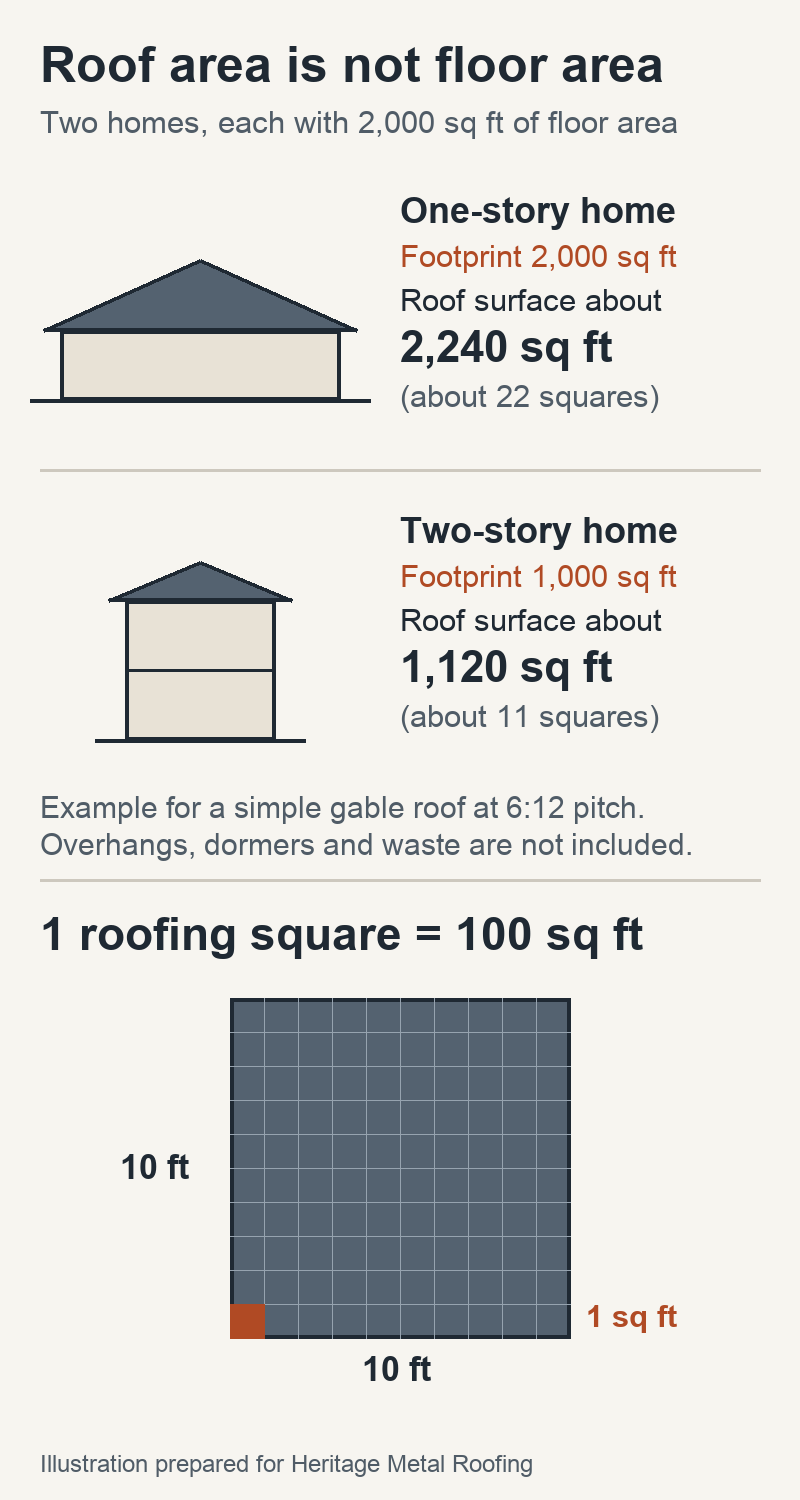
Roofing is priced on the area of the roof surface, measured along the slope. That is a different number from the square footage on a real-estate listing, which counts living space.
Two things separate them. First, the roof covers the footprint of the house, not its floors. A two-story home with 2,000 square feet of living space may sit on a footprint of about 1,000 square feet, while a one-story home of the same size covers about 2,000. Second, a sloped roof has more surface than the flat area beneath it. On a simple gable roof at a 6:12 pitch, the surface is about 12 percent larger than the footprint it covers. In that example the one-story roof is about 2,240 square feet and the two-story roof about 1,120. Overhangs, dormers, attached garages and porches add more.
So “a 2,000-square-foot home” does not tell anyone how big the roof is. When you read a price example based on home size, check whether it means floor area or roof area. On a proposal, look for the measured roof area.
A roofing “square” is 100 square feet
Roofers measure in squares. One square is 100 square feet of roof surface, a 10-by-10-foot area. A price of $1,000 per square and a price of $10 per square foot are the same price in different units.
Materials-only prices are not installed prices
A materials price covers the panels, and sometimes the trim. An installed price also covers labor and, depending on who is quoting, some or all of the tear-off, disposal, underlayment, flashing and permits. Two figures can look far apart only because one is materials and the other is installed.
What published prices say about stone-coated steel
The price for your roof comes from a written estimate based on that roof, and Heritage provides free written estimates. The two figures below are from other publishers. They are market context only. They are not Heritage quotes, not Oakland County averages and not a budget for your home.
- Mid-Michigan, 2026. Weather Vane Roofing, a contractor in Lansing and Owosso, published a Michigan price guide dated May 22, 2026. It lists stone-coated steel at $10 to $15 per square foot and says its ranges “come from projects across Mid-Michigan” and are “installed costs.” It lists tear-off, underlayment, ventilation and permits as separate line items and does not say plainly whether the per-square-foot figure already includes them. Its example totals are for “a 2,000 sq ft home,” without saying whether that is floor area or roof area.
- National, 2023. HomeGuide’s metal shingle roof cost guide is dated April 5, 2023. It lists stone-coated steel shingles at $7 to $13 per square foot “for labor and materials,” and treats removing the old roof as a separate cost. Because of its date, read it as older background rather than a current price.
The two figures differ because they come from different places and years and do not state the same inclusions. We have not combined or averaged them.
One labelling point matters when you read guides like these. Some list “metal shingles” and “stone-coated steel” as separate lines at different prices. Heritage’s metal shingle roofs use Tilcor stone-coated steel, so the stone-coated line is the one to read. Standing seam is a different system; our standing seam cost guide covers what moves that price.
What affects the price of a metal shingle roof
1. The system, profile and color. Heritage’s metal shingle roofs use Tilcor stone-coated steel: steel panels with a stone-granule finish, in three profiles shaped like shingles (CF Shingle), wood shake (CF Shake) or tile (Antica). Other manufacturers make metal shingles in other materials and finishes, which is one reason a proposal should name the product. Specific colors and availability are confirmed with your estimate. Our guide to stone-coated steel roofing explains the material.
2. Roof surface area. More surface means more panels, more underlayment and more labor. The measured roof area belongs on every proposal.
3. Pitch. A steeper roof has more surface over the same footprint, and working on it calls for extra safety measures. Pitch also decides which products can be used at all. Our minimum roof pitch guide covers how pitch affects system choice in Michigan.
4. Complexity. Valleys, hips, dormers, skylights, chimneys and changes in roof plane all need panels cut to fit, plus trim and flashing. Two roofs with the same area can involve very different amounts of work.
5. Tear-off or installing over the old roof. For a metal shingle roof, Heritage’s typical process is a full tear-off: removing the existing roofing down to the decking, inspecting the decking and installing the new system from there. Tilcor’s installation guide allows CF Shingle over one layer of asphalt shingles where local code permits, and Heritage treats that as the exception, assessed roof by roof. The two approaches are priced differently, so a proposal should say which one it covers. Our guide to a metal roof over shingles vs. a full tear-off explains the tradeoffs.
6. Deck condition. The panels fasten to the roof deck, and Tilcor’s guide requires sheathing that is structurally sound. Damaged decking is replaced before the new roof goes on, and its full condition is often not known until the old roofing is off.
7. Underlayment and eave protection. Underlayment goes over the deck before the panels. Tilcor’s guide sets a minimum underlayment standard, lists self-adhered membrane as an option, and says to install an ice barrier where required in areas with frequent freeze and thaw cycles.
8. Flashing, trim and ventilation. Edges, walls, valleys, chimneys and pipes each need their own flashing or trim pieces, and ventilation may be part of the scope. These details are a common place for two proposals to differ.
9. Labor. Labor is a major part of an installed price, which is why complexity counts for as much as it does.
10. Disposal. A tear-off produces a roof’s worth of old material to haul away.
11. Project-specific requirements. Permits, local code requirements and anything particular to your home, such as a detached garage you want included, can change the scope.
How to compare written proposals like for like
Two proposals are comparable only when they describe the same job. Before comparing totals, check that each one states:
- The roof area it is priced on, in squares or square feet. If two contractors measured very different areas, sort that out first.
- The exact product: manufacturer, system and profile. “Metal shingles” alone is not enough.
- Tear-off or overlay, how many layers are being removed, and whether disposal is included.
- Deck repairs: how they are priced if damage is found.
- Underlayment and eave protection: which products, and where.
- Flashing, trim and ventilation: what is new and what is reused.
- Permits, included or not.
- Warranties: the written terms of the installer’s workmanship warranty and of the manufacturer’s warranty, as two separate documents.
- Exclusions. A short list of what is not included is as useful as the list of what is.
Two more things are worth raising in the conversation. Ask how the crew will reach the roof and where materials and a dumpster will go; if anything about your property makes that unusual, the proposal should reflect it. And if you are also looking at a different kind of metal roof, check how its panels are fastened, because that changes what you are buying. Our guide to concealed vs. exposed fasteners explains the difference.
If one total is much lower than another, look at why before deciding. The measured area, the product, the scope and each contractor’s own pricing can all differ, and the written proposals are where those differences show.
Planning a metal shingle roof in Oakland County
Heritage Metal Roofing is based in Sterling Heights and takes metal roof installation and replacement jobs throughout Oakland County. Every project starts with a conversation about your home and an assessment of the roof, followed by a free written estimate specific to that roof. To see the metal shingle profiles we install, visit our metal shingle roofing page. When you are ready for a number for your own home, request an estimate or call (248) 270-2784.
Common questions
How much does a metal shingle roof cost per square foot?
It depends on the roof and on what the figure includes. The section “What published prices say about stone-coated steel” above quotes two published figures with their dates and limits. Neither is a Heritage price. For your own roof, request a written estimate.
Is my roof the same size as my house?
Usually not. Roofing is priced on the roof’s surface, measured along the slope. That depends on the home’s footprint, the pitch, and the overhangs and other roof sections, not on the living area.
Does a metal shingle price include tearing off the old roof?
Not always. Both published guides quoted above list tear-off as a separate item, and proposals differ. A full tear-off is Heritage’s typical process for a metal shingle roof, and the written estimate says what is included.
Can I get a price without a roof assessment?
A published range can help you plan. A price you can rely on comes from measuring and looking at the roof, because pitch, complexity and the existing roof all change it.